Section 10 of 440
PART 1: FOUNDATION
1.1 PHILOSOPHY & ARCHITECTURE
Understanding the assumptions behind the Titan Protocol makes it easier to adapt the framework when progress slows or circumstances change.
This section offers mental models for thinking more carefully about practice, recovery, measurement and adaptation.
HUMAN CAPABILITY ENGINEERING: THE FOUNDATION BENEATH TITAN
Human Capability Engineering is the engineering discipline concerned with the systematic specification, formation, verification, transfer, incorporation, maintenance, augmentation, recovery and retirement of human capabilities - not the engineering of human beings. Titan is its first reference implementation.
THE GOVERNING DEFINITION
A capability is not a permanent substance stored inside a person. It is an evidence-bounded relationship between a declared actor or human-in-system configuration and a class of tasks, expressed through reliable outcomes under stated conditions, constraints, supports and time boundaries.
This sounds technical because it corrects several common errors at once. A person is not simply “good at memory,” “bad at focus,” “resilient” or “a leader” in every setting. The meaningful question is narrower: what can this person, team or human-technology configuration reliably do; on which tasks; in which environment; with which support; to what criterion; at what burden; and how current is the evidence? A capability claim becomes useful when those boundaries are visible. It becomes misleading when they disappear.
Capability is a relationship, not a label
HCE separates the person from the claim. The same person may meet a criterion in one configuration and not another: rested rather than sleep-deprived, seated rather than standing, using an assistive device rather than unaided, working alone rather than inside a coordinated team, or using one version of an AI tool rather than another. That does not make the result unreal. It means the system of interest must be declared honestly.
The configuration also determines where responsibility lies. A team result is not automatically an individual trait. An AI-assisted output is not unassisted human performance. A supported route is not lesser, but the support must be named. If the support changes, the claim may change. If the criterion or protocol changes, a new assessment context begins rather than quietly rewriting the old one.
The elements of a defensible capability claim
Before an operational claim can be interpreted, HCE asks for the following elements. They do not all need elaborate instrumentation; they do need enough clarity to prevent the result expanding beyond what was actually tested.
Element | Question Titan must answer |
|---|---|
Actor / system | Who or what configuration is performing: an individual, a team, an assisted person, or a human-technology system? |
Task class | What bounded action or set of comparable actions is being assessed? |
Outcome and criterion | What observable result counts, and what threshold or decision rule was declared before observation? |
Environment | Which physical, social, informational and technological conditions materially affect the result? |
Constraints | Which limits, exclusions, risks, time pressures or professional boundaries apply? |
Supports | Which aids, adaptations, people, prompts, devices or interfaces are part of the tested configuration? |
Evidence | How was performance recorded or verified, and what does that evidence fail to establish? |
Time | When was the result observed, when is review due, and what would make the claim historical, lapsed or retired? |
These elements form the claim boundary. The boundary is not bureaucratic decoration. It is what stops a laboratory task becoming “general intelligence,” a wearable signal becoming a diagnosis, a good day becoming a stable trait, or a supported result being misrepresented as unaided performance.
Capability formation is broader than training
Titan often uses practice, but HCE uses the broader term formation. A capability relationship can change through learning and repetition, but also through recovery, coaching, environmental redesign, an accessibility route, better coordination, a new tool, a prosthesis, an AI system or the removal of an unnecessary obstacle. Sometimes the best engineering decision is not to make the person work harder. It is to redesign the task or environment so the intended function becomes safe, sustainable and available.
Formation therefore includes acquisition, reacquisition, restoration, substitution, augmentation and collective coordination. It also includes a legitimate negative result: a protocol can be paused, rejected or retired because the burden is excessive, the transfer is absent, the risk is unacceptable or the outcome is no longer useful. “Stop” is an engineering decision, not a moral failure.
Proof arrives in stages
Immediate improvement is only the beginning. HCE keeps several evidentiary stages separate because each answers a different question. Direct performance asks whether the declared criterion was met now. Retention asks whether it remains after a delay. Transfer asks whether it appears on a predeclared novel task or context. Incorporation asks whether a new signal or method is being integrated into ordinary performance rather than consciously translated each time. Automaticity asks whether useful performance survives reduced attention or a secondary task. Maintenance asks whether later comparable evidence still supports the same claim.
One stage never silently substitutes for another. Acquisition is not retention. Retention is not transfer. Transfer is not incorporation. A feeling of fluency is not objective performance. A brain image, biomarker or device signal may support a mechanism claim, but it does not replace the functional outcome unless that signal is itself the declared outcome.
Titan’s L1-L5 scale remains a task-specific performance scale. The HCE Capability Maturity Vector records additional evidenced dimensions only where they apply. It is metadata, not L6, not a global capability score and never a measure of human worth.
Accessibility and support are constitutional, not optional
A wheelchair, hearing aid, screen reader, prescribed medication, support person, checklist or AI interface may be a constitutive part of the capability system. HCE does not penalise an assistive route merely because support is visible. The question is whether the intended function is preserved, the route is safe and sustainable, and the claim accurately names the configuration that produced the result.
This principle is already expressed by Titan’s Context Envelope: adapt the protocol to the person; never force the person to fit the protocol. HCE turns that doctrine into an operational rule. Accommodation is recorded, not scored as failure. “Not assessed” remains blank rather than becoming zero or L1. A professional restriction, a decision not to test, or an inaccessible task does not become evidence of low capability.
The two Titan lanes remain separate
The frozen Core is a broad, non-scoring planning model. Its twenty-four domains help you reflect on your present situation, map which domains may bear on a declared outcome and compare integrated Program routes. Profile entries are not operational capability levels, diagnoses or population ranks. Programs schedule education and practice; completing one does not prove a capability.
The Capability Standard is the narrower HCE route. It begins with a declared task and criterion, preserves the baseline, records support and burden, distinguishes evidence modes, and tests retention and transfer when the claimed level requires them. Its result belongs only to that module, task and versioned context. It is never averaged into the Core.
Lifecycle, currentness and honest history
Capability evidence ages. Titan therefore records performance level separately from lifecycle state. A result may be Current, Maintained, Review due, Historical or Criterion not met. A later recovery result does not erase an interruption. A changed criterion or protocol starts a new assessment context. Failed attempts, adverse events and superseded declarations remain part of the evidence history, subject to lawful privacy handling.
This protects the system from success-only memory. It also makes maintenance visible. Some capabilities persist with little refresh; others decay quickly or depend on continued access to a device, team or environment. Maintenance is part of engineering the capability, but it is never a higher level than the performance actually demonstrated.
A practical HCE check before you begin
Before starting any capability protocol, answer nine questions:
What real outcome matters?
Which bounded task will represent that outcome?
Who or what configuration is performing?
What environment, constraints and supports must be declared?
What result counts, and is the criterion fixed before observation?
How will direct performance be recorded or independently verified?
What delayed retention and genuinely novel transfer tests are justified?
What burden, adverse effects and stop rules will be recorded?
When will the evidence be reviewed, maintained, amended, suspended or retired?
If those questions cannot yet be answered, the work may still be useful exploration, but it is not ready for an operational capability claim. The Candidate Lab and Research Observatory exist precisely so Titan can investigate possibility without turning uncertainty into proof.
HCE does not promise that every person can acquire every capability, that improvement is unlimited or that engineering language removes biological and social constraints. It supplies a disciplined way to discover what can be formed, what can be demonstrated, what transfers, what persists, what it costs, and when the responsible decision is to stop. The chapters that follow apply that discipline through Titan’s Hardware, Operating System and Applications architecture.
Research-governance boundary. Appendix AC explains the Titan Research & Governance Lab, the single subordinate programme that indexes Titan’s research branches through one master register, one archive and one promotion process. Capability Commons and Multi-Locus Capability Architecture v0.2 remain candidate source systems inside that programme. Consolidation does not amend HCE v1.0, the frozen Core, the sixteen operational modules, L1–L5 or any assessment, and it creates no public product or automatic promotion route.
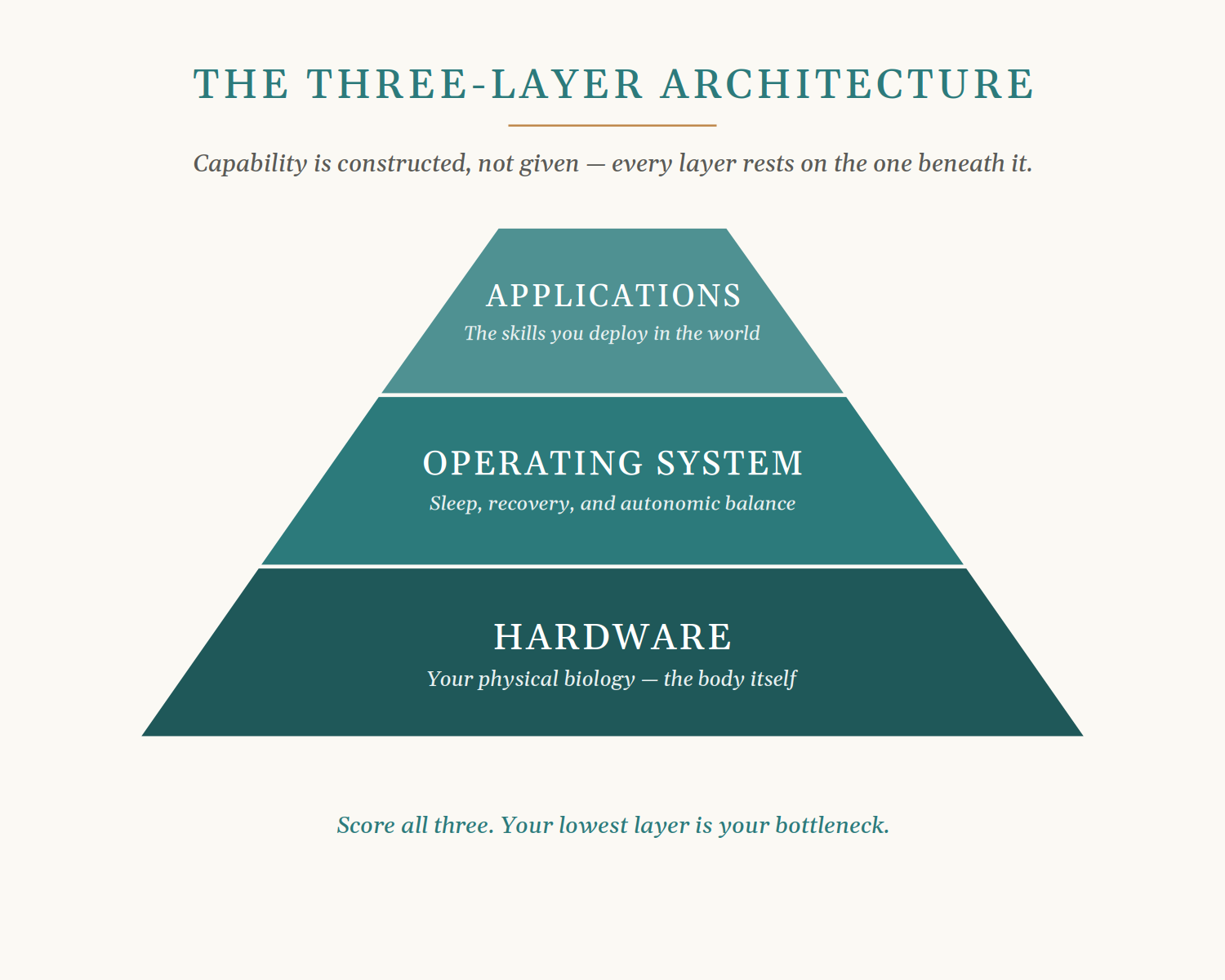
Three-layer dependency diagram for section 1.1: Applications run on the Operating System, which runs on Hardware.
Human Capability Is Neither Fixed nor Limitless
Human capability is neither wholly fixed nor wholly self-constructed. Many trainable tasks respond to practice, while genetics, health, disability, age, opportunity and environment set real constraints.
Neuroplasticity research shows that experience and practice can be associated with task-relevant changes in brain activity, structure and performance. Those findings do not establish unlimited change, a universal mechanism or the result any one reader will obtain.
The same principle applies to every system in your body:
Appropriately dosed resistance and endurance training can produce task-specific musculoskeletal and cardiovascular adaptations. Hormonal and immune responses are more complex, vary by person and context, and are not general targets for unsupervised optimisation.
Gene expression can vary with development and environment, but that does not mean a person can deliberately rewrite every inherited constraint. Treat biology as a set of influences and boundaries, not as destiny or personal failure.
Practice and environment can influence some future outcomes, but current health and capability are not simply the result of past choices. Use the framework to find one feasible, trainable task without turning limitation into blame.
Genetics, age, disability, health, resources and circumstances set real parameters. Section 1.5 exists to honour them. Within that context, some capability gaps may respond to appropriate practice; others may call for accommodation, acceptance or qualified support.
READ THIS BEFORE THE ARCHITECTURE HARDENS: No layer runs outside a life. If you carry disability, chronic illness, neurodivergence, caregiving load, or hard material constraints, section 1.5 — The Context Envelope — governs everything that follows. Its doctrine rules this entire book: adapt the protocol to the person. Never force the person to fit the protocol. The hierarchy describes dependencies, not eligibility: limited or permanently altered Hardware does not disqualify higher-layer development — every protocol adapts through the Envelope.
The Biological Truth: Adaptation via Signaling
Many biological adaptations are use-, task- and dose-dependent, but the body is not a simple resource-allocation machine. Response varies with health, age, recovery, environment and the specific task.
Appropriately programmed resistance training can support strength through muscular, neural and technical adaptations. Some gains diminish when practice stops; the amount and time course vary.
Temperature exposure is not a general-use Titan training signal. Its responses and risks vary, and this book does not prescribe cold or heat progressions.
Focused-attention practice may improve performance on the practised attention task. Do not infer broad cognitive enhancement or a particular neural mechanism from a personal result.
Adaptation is task- and dose-specific. Practice can improve a trained movement or cognitive task, while adequate recovery supports retention. Do not infer a universal hormonal, metabolic or emotional response from a single stressor, and do not treat fasting or carbohydrate restriction as general-use signalling protocols.
Use the principle to ask a narrower question: “What safe task can I practise, what outcome will I measure, and what would make me stop or seek help?”
Consistent, appropriate practice makes a task easier to evaluate, but it does not guarantee a particular adaptation or outcome.
THE TITAN MINDSET
Before the technical architecture, consider five working assumptions that constitute the Titan Mindset. Test them against your context; they are not conditions of personal success or failure.
1. Capability Is Neither Fixed nor Unlimited
Some task performance can change through practice, support, treatment, assistance or environmental redesign. Genetics, age, disability, health, access, opportunity and circumstance also create real constraints, and HCE does not assume that every capability can or should be expanded.
A current result describes performance under recorded conditions; it does not define identity or reveal a guaranteed ceiling. The word “yet” can be useful only where a safe, feasible route exists. It is not an obligation to improve, a reason to deny permanent limits or a substitute for accommodation, acceptance or qualified care.
2. Adaptation Is Task- and Dose-Specific
Hormesis describes some non-linear dose responses; it is not a licence to assume that any stressor produces a net benefit. Exercise adaptation is task- and dose-specific, vaccination is medical care rather than a self-experiment, and Titan does not claim that fasting generally improves an individual’s metabolic health.
Some physical and cognitive tasks use progressively adjusted practice followed by recovery. Other capability relationships form through teaching, assistance, substitution, environmental design, treatment or reciprocal adaptation. No single “stress–recover–grow” model governs every Titan domain.
Increase difficulty only when the declared task, direct outcome, symptoms, burden, technique and safety rules support it. More intensity is not a higher capability, discomfort is not proof of adaptation, and a response in one task does not establish transfer to another.
Practical application: predeclare the task, load and stop rule. Preserved technique and symptom-free effort can support gradual practice; new, sharp, worsening, neurological or unexplained pain, chest symptoms, faintness, uncontrolled breathing or distress stop the session and route to appropriate care.
3. Measurement Enables Management
What gets measured becomes more visible. Measurement can support reflection, but it can also mislead or distort behaviour when the measure is unreliable or becomes the target.
Use the least burdensome measure that fits the question. Consumer sleep and HRV devices estimate limited signals and are not diagnostic; subjective experience, symptoms and qualified assessment may matter more than one displayed number.
Titan uses the least burdensome measure that matches the question. Direct task results, symptoms, function, support and burden usually matter more than collecting biometrics. HRV, resting heart rate and consumer sleep estimates are optional context when appropriate; they are not required and do not diagnose readiness, recovery or health.
This serves multiple purposes:
Baseline establishment: a comparable starting observation can make later change easier to interpret; absence of a formal baseline does not make lived change unreal or justify unsafe testing.
Progress check: a predeclared task measure can show whether that specific result changed under recorded conditions. It does not prove causation or override symptoms and lived experience.
Protocol review: when a declared result stagnates, declines or carries excess burden, review measurement quality, context, safety and value before keeping, adapting, pausing or retiring the approach.
Feedback and adherence: some people find visible progress useful; others experience pressure, anxiety or distorted priorities. Keep only measures whose benefit exceeds their burden.
Pattern review: over time, you may notice associations worth testing more carefully. A personal correlation does not establish cause.
Practical application: choose one direct measure for the current task, one burden or symptom check and one review date. Add another measure only when it answers a defined question and does not increase privacy, anxiety or tracking burden beyond its value.
4. Serial > Parallel Optimization
The temptation when starting any optimization program is to change everything at once. New diet, new exercise routine, new sleep schedule, new meditation practice, new supplements—all starting Monday.
This approach fails for two reasons:
First, you can’t distinguish what’s working. If you change ten variables and improve, you don’t know which changes drove the improvement. If you change ten variables and feel worse, you don’t know which to eliminate.
Second, changing many variables at once increases practical burden and makes the record harder to interpret. The result may be lower adherence, more fatigue, or uncertainty about which change helped or harmed. This is a design problem rather than a universal law of finite willpower: reduce simultaneous changes when burden or interpretability deteriorates.
A serial approach changes fewer material variables at once and may improve feasibility or interpretation. It is a planning option, not a universal rule: preserve essential care and supports, and use parallel work where the task, team or life context requires it.
This may feel slow, but it reduces simultaneous changes and makes results easier to interpret. Whether it improves adherence or performance depends on the person and task.
Practical application: name one primary purpose for the current cycle, then record the minimum supporting work needed to preserve health, access, obligations and already-valued capabilities. Titan sets no 80/20 allocation or universal limit on secondary items.
Which secondary items to maintain is not arbitrary—it depends on your primary target, because the systems are linked. A few constraint clusters are worth knowing:
• Working on a strength task? Preserve adequate sleep opportunity, nutrition and recovery within your individual guidance. Do not use sleep-stage estimates, protein targets or training intensity to infer a hormone result.
• Working on cognition, focus or emotional regulation? Record sleep opportunity, symptoms, workload, movement and environmental conditions when they appear relevant. These factors can affect performance, but no single routine is a prerequisite or treatment for every person.
• Working on sleep or recovery itself? Protect adequate sleep opportunity, use ordinary daytime light and movement as feasible, and review caffeine timing if it appears to affect sleep. None is a universal lever or guaranteed treatment.
The rule holds in each case: your one Program is where the effort goes, while ordinary sleep opportunity, appropriate movement, nutrition and hydration stay at “good enough”. You are focusing, not abandoning. Operational capability modules remain a separate lane.
5. You Are the Experiment
Population evidence estimates effects and uncertainty in studied groups. Individual response may differ because of health, history, context, access, support, task design and chance. A personal observation can inform one bounded decision, but it cannot reveal hidden biology, establish general causation or outrank qualified evidence.
The Titan Protocol provides educational starting points for low-risk self-observation. Personal experiments cannot diagnose disease, establish general causation or replace professional care. A bounded experiment requires:
Hypothesis formation: “I hypothesize that ten minutes of morning outdoor light will improve my predeclared afternoon alertness measure.”
Controlled testing: Implement the intervention consistently for a defined period while keeping other variables stable.
Data collection: Track relevant outcomes objectively and subjectively.
Analysis: Did the intervention produce the predicted effect? At what magnitude?
Iteration: Based on results, continue, modify, or abandon the intervention.
This approach encourages a narrower claim: record the task and conditions, review the result, and change course when the burden, safety or evidence does not support continuation.
Responses may be helpful, neutral or harmful. Stop for adverse effects, respect the exclusions, and involve a qualified professional whenever the decision carries material health or other risk.
Practical application: Keep an “N=1 experiment log.” Document every significant protocol change, including the rationale, implementation details, duration, outcome measures, and conclusions. Over time, this becomes an invaluable reference for understanding your personal biology.
THE THREE-LAYER ARCHITECTURE
The Titan Protocol organizes human function into three distinct layers, each building upon the one below. Understanding this architecture is crucial for effective optimization because it determines where to focus your efforts and in what order.
Layer 1: HARDWARE (Biological Stacks)
The Hardware layer encompasses your physical and biological systems—the fundamental substrate upon which everything else runs. This includes:
Structural systems: Bones, joints, connective tissue, and musculature that enable movement and provide physical capability.
Cardiovascular systems: Heart, blood vessels, and blood that deliver oxygen and nutrients throughout your body.
Metabolic systems: Hormones, enzymes, and cellular machinery that regulate energy production, storage, and utilization.
Neurological systems: Brain, spinal cord, and peripheral nerves that process information and coordinate action.
Immunological systems: White blood cells, antibodies, and lymphatic tissue that defend against pathogens and manage inflammation.
Hardware is Titan’s planning metaphor for physical and biological conditions relevant to a task. Illness, pain, fatigue, disability, medication, nutrition, sleep and environment can influence performance, but the metaphor is not a diagnostic causal chain and does not rank one body as more worthy or universally capable than another.
Hardware planning may involve a safe functional movement or exercise task, ordinary nourishment and sleep opportunity, accessibility, symptom management and qualified preventive or clinical care. Titan does not use metabolic flexibility, hormone values, body composition or “biological resilience” as universal optimisation targets.
Layer 2: OPERATING SYSTEM (Restorative & Autonomic)
The Operating System layer manages how your Hardware functions—the regulatory systems that maintain balance, enable recovery, and coordinate responses to changing demands. This includes:
Autonomic nervous system: The sympathetic (“fight or flight”) and parasympathetic (“rest and digest”) branches that regulate arousal, recovery, and stress response.
Sleep processes are involved in memory, physiology and daytime function, but consumer stage estimates do not diagnose restoration or provide universal deep- or REM-sleep targets.
Breath regulation: The voluntary and involuntary control of breathing that influences nervous system state, blood chemistry, and cellular oxygenation.
Stress response systems: The HPA axis (hypothalamus-pituitary-adrenal) and related systems that mobilize resources for challenges and restore baseline after threat passes.
The Operating System is a planning metaphor for sleep, recovery, workload and state regulation. It does not diagnose a person as optimal, dysfunctional or dysregulated, and it does not identify the cause of fatigue, mood change or cognitive symptoms.
Operating System planning may address sleep opportunity, workload, comfortable breathing, task-specific recovery, environmental support and attention. HRV is optional, device-dependent context rather than a measure of autonomic balance, resilience or readiness.
Layer 3: APPLICATIONS (Interface & Output)
The Applications layer comprises the capabilities you deploy in the world—the skills, knowledge, and competencies that translate biological potential into real-world performance. This includes:
Cognitive applications: Memory, attention, learning, creativity, problem-solving, and decision-making capabilities.
Emotional applications: Self-regulation, resilience, emotional intelligence, and the ability to manage internal states.
Social applications: Communication, influence, leadership, negotiation, and relationship-building skills.
Financial applications: Economic reasoning, risk assessment, wealth building, and resource management capabilities.
Physical applications: Sport-specific skills, combat capability, survival skills, and motor learning.
Creative applications: Artistic expression, innovation, narrative construction, and aesthetic sensitivity.
Applications are the task-specific capabilities deployed in the world. Their performance may be affected by health, sleep, environment, support, opportunity and practice, but the three-layer metaphor does not prove a fixed causal order or require a person to “repair” lower layers before meaningful learning, creativity, relationships or contribution.
THE OPTIMIZATION HIERARCHY
The three-layer architecture is a prioritisation aid, not a universal biological sequence. Start with urgent safety or care needs, then choose the feasible task with the clearest value and most plausible constraint hypothesis. Hardware, Operating System and Application work may occur in different orders or together.
Why Hardware First
Physical conditions can influence performance, but the contribution of cardiovascular, metabolic, endocrine, neurological and environmental factors differs by person and task. These mechanisms do not allow a book or Cockpit record to diagnose the cause of attention, mood, learning or social difficulty.
When Hardware is compromised, everything downstream suffers. Consider the cascade effects of poor metabolic health:
Possible relationships among metabolism, inflammation, hormones, sleep and performance are complex and bidirectional. The three-layer diagram is not a causal chain, diagnostic model or basis for self-treatment.
Some symptoms and physical constraints require medical care, rehabilitation, accommodation or reduced load rather than a performance technique. At the same time, disability or chronic illness does not disqualify cognitive, social, creative or assisted capability formation. Route the actual limitation instead of assuming a universal lower-layer cause.
Hardware work is limited to the declared function and the route appropriate to the person. It may include clinician- or coach-approved movement, rehabilitation, assistive technology, accessible environment design or ordinary health support; it does not prescribe hormone, body-composition or metabolic targets.
Hardware routing check: before adding load, confirm that the selected task is appropriate for you, that symptoms and ongoing conditions follow the relevant professional route, and that sleep, nutrition and recovery are not being sacrificed. Titan supplies no universal exercise-duration, sleep, glucose or blood-pressure clearance threshold.
Why Operating System Second
Sleep opportunity, workload, pain, medication, environment, support and stress can alter performance from day to day. Titan uses the Operating System metaphor to make those conditions visible; it cannot infer a hidden autonomic state from HRV, sleep-stage estimates or subjective energy.
There is no universal Operating System threshold before Application work. Begin or continue a capability task when it is safe, meaningful and feasible under the person’s actual conditions, using treatment, assistance, pacing or adaptation where needed. Persistent symptoms or functional decline use the relevant qualified route.
Why Applications Last
Applications do not universally come last. Learning and performance can proceed alongside healthcare, disability, fluctuating energy, caregiving and constrained resources when the route is adapted and safe.
Lower-layer conditions may affect a particular task, but they do not guarantee slow learning, poor retention or rapid degradation. Measure the declared task, preserve access and recovery, and test any claimed dependency rather than assuming it from the architecture.
The sequence starts with lower-burden foundations because they are easier to observe and protect while another task is practised. No cross-domain return is assumed.
THE NORTH STAR: CAPACITY WITH RECOVERY
Titan develops demonstrated capacity on declared tasks while preserving health, consent, access and recovery. Capability is not the opposite of well-being. Rest, support, treatment, assistive technology and a lower-burden route can be the conditions that make reliable performance possible.
Appropriate effort may feel demanding, but discomfort is not evidence that an intervention works and pain is never a character test. Predeclare the task, criterion, support and stop rule; preserve technique; and stop for new, sharp, worsening, neurological or unexplained pain, chest symptoms, faintness, severe breathlessness, panic escalation, loss of coordination or distress. Persistent symptoms route to qualified care.
The guiding question is: “What can I demonstrate safely and repeatably under the stated conditions?” A supported or adapted result is not lesser. Maintenance at a meaningful ceiling can be as valuable as improvement, especially through ageing, disability, illness, caregiving or a constrained season of life.