Section 8 of 440
Start Here: Find Your Entry Point
Exertion boundary. If physical, cognitive or emotional effort reliably makes you worse afterwards — particularly when the worsening is delayed by hours or days and takes a long time to pass — do not begin this material. Read section 5.7.1 first. The method used here is not safe for you and the general safety screen was not written to detect that.
A book this size can feel like a wall. It isn’t one. You do not start at page one and march to the end—you start where your life is hardest right now. Find yourself below and begin there. Every path leads to the same loop; this is simply your on-ramp to it.
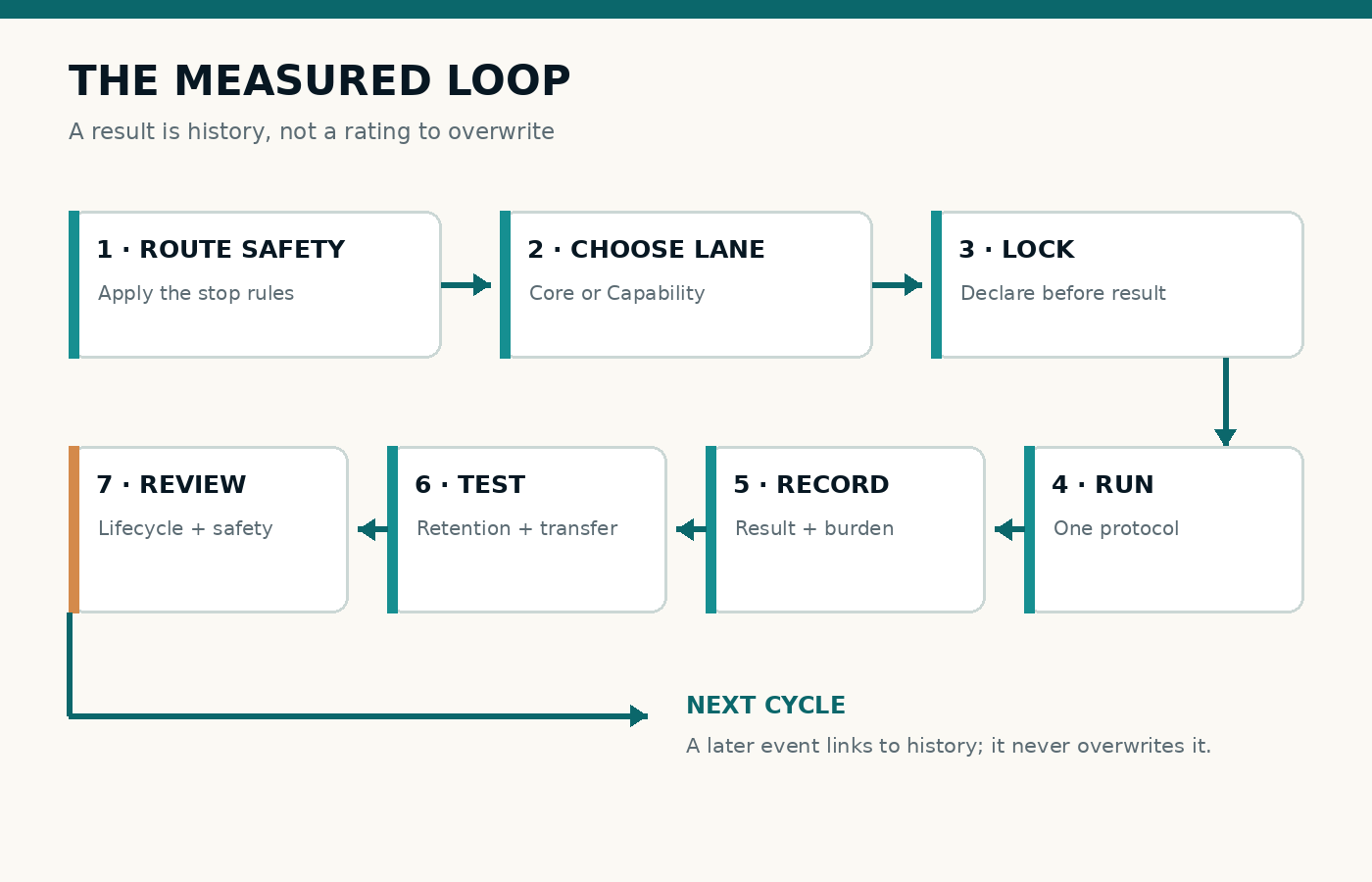
The Titan Loop: screen, declare an outcome, map constraints, compare routes, act, review and retest.
If you feel persistently exhausted or burned out. Symptoms can have medical, psychological and situational causes, so use qualified care where appropriate. For the educational lane, begin with the Safety Screen and compare low-burden routes; do not use a Cockpit record to diagnose or “restore” a nervous system.
If weight or metabolic health is a concern. Start with the clinical and eating-disorder boundaries in Part 2. Individual targets belong with a qualified clinician or dietitian; Program B can be adapted only after that route is clear.
If you feel anxious or chronically stressed. Begin with the mental-health boundary and qualified support when symptoms persist or affect daily life. Program C offers low-burden observation practices, not anxiety treatment or autonomic control on demand.
If your work feels scattered. Start with the current-state profile in §1.2 and the outcome-and-route review in §1.3. Choose one integrated Program or one declared operational module, keep their records separate, and measure a specific task rather than labelling yourself as lacking focus.
If you are already fit and want more. Start with Applications—the cognitive, emotional, social, and financial chapters of Part 2—and the integrated Programs in Part 3. Add one defined target at a time and keep its result separate from an operational capability-module assessment.
If you are older and focused on function. Start with the safety screen, current clinical guidance and the phase-of-life adaptation material in §4.1. Use appropriately supervised strength, aerobic or mobility work only as it fits your health and goals; no Program promises longevity or protection from decline.
If you are injured or working with limited capacity. Start with the boundary doctrine and safety screen, then follow the treating professional’s restrictions. Even breathing, sleep, nutrition and cognitive practices can need adaptation. Add physical load only through the qualified return plan; limited capacity is not a disqualification or a reason to force another domain.
If you are a builder, entrepreneur or creator. Start with the cognitive and financial chapters of Part 2, then choose one relevant Program. Protect adequate sleep and recovery without assuming they cause a business outcome. Track burden beside results and reassess when either worsens.
Whichever door you came through, the loop is the same: screen, choose one bounded target, use either a Program or a declared operational module, track, review the direct result, currentness, burden and next decision, and do not combine the two lanes.